EDUCATIONAL SCIENCE PLATFORM — NOTHING HERE IS MEDICAL ADVICE — NOTHING HERE IS FOR SALE
CARPHEDON · PHENYLPIRACETAM · FONTURACETAM · CAS 77472-70-9
Carphedon — the Soviet cosmonaut-era racetam, on the record
INN fonturacetam · Phenotropil · C12H14N2O2 · MW 218.25
carphedon.com is an independent science platform about phenylpiracetam — the molecule the USSR Institute of Biomedical Problems developed to increase the mental and physical performance of cosmonauts. The full ledger: what it is, how it works, what the Russian clinical literature actually found, why WADA lists it, and what nobody has yet shown.
Educational research communications. Nothing here is medical advice. Nothing here is for sale.
Every scientific claim on this site traces to a live-verified primary source in the references library — null and mixed results included, at equal prominence.

THE SHORT ANSWER
Carphedon, in four sentences
Carphedon is the original name of phenylpiracetam — piracetam with a phenyl ring added at the 4-position — developed at the USSR Institute of Biomedical Problems to increase the mental and physical performance of cosmonauts, and sold in Russia as the prescription medicine Phenotropil.[5][3]
Its best-documented mechanism is dopamine-transporter inhibition by the R-enantiomer of the racemate — the property that made it, in 1998, the first nootropic ever prohibited in sport, where it remains on WADA’s strictest stimulant tier.[8][29]
The human evidence is thin and single-country: one double-blind trial with a mixed outcome, large open Russian studies, and a 2025 meta-analysis of 549 asthenia patients that pools only small studies — while human pharmacokinetics have never been published at all.[16][15]
This site publishes the whole ledger — the cosmonaut legend with its documentary boundaries drawn, the mechanism without the AMPA myth, the trials with their nulls at equal prominence, and the long list of what nobody has yet shown.
ONE MOLECULE, FIVE NAMES
Carphedon → phenylpiracetam → fonturacetam
The 1983 discovery paper called it 4-phenylpiracetam. The Soviet programme called it carphedon — a name still on the analytical literature in 1999. Russian pharmacies know it as Phenotropil and Actitropil. The WHO’s international nonproprietary name, fonturacetam, entered the literature around 2023. WADA’s Prohibited List compresses the entire chain into one entry: “Fonturacetam [4-phenylpiracetam (carphedon)]”.[3][4][28]
- Original name
- carphedon (карфедон)
- Research name
- phenylpiracetam · 4-phenylpiracetam
- INN (WHO)
- fonturacetam
- Russian brands
- Phenotropil · Actitropil
- Identifiers
- CAS 77472-70-9 · PubChem CID 132441
THE MOLECULE IN NUMBERS
Identity, history and evidence — counted
Every figure traces to the live-verified source library; the unflattering counts are displayed with the same prominence as the flattering ones.[1]
- 77472-70-9
- CAS number — one molecule, many names
- carphedon · phenylpiracetam · fonturacetam
- 218.25
- Molecular weight, C12H14N2O2
- piracetam + one phenyl ring
- 1983
- First scientific description
- as “4-phenylpiracetam” — PMID 6403074
- 1998
- First nootropic prohibited in sport
- still the only racetam on the WADA list
- 1
- Double-blind placebo-controlled trial
- n=90, epilepsy add-on — mixed outcome
- 549
- Patients in the 2025 meta-analysis
- 11 Russian studies · 5.5% transient side effects
THE ORIGIN, DOCUMENTED
Built for orbit: the IBMP cosmonaut programme
Two independent peer-reviewed sources state the origin plainly: phenylpiracetam was developed at the Institute of Biomedical Problems — the Soviet space-medicine institute — as a new-generation psychostimulant to sustain the mental and physical performance of space crews across the stages of flight.[5][6]
What the record does not contain is just as interesting: no primary document confirms the famous Mir medical-kit anecdote, and no source at all supports the Chernobyl-liquidator story — the closest real link is a 2016 animal study aimed at future radiation-accident responders. The history page draws both boundaries in full.[41]
HOW IT WORKS
A dopamine-transporter inhibitor hiding in a racetam
The marketed drug is the racemate, but the pharmacology belongs mostly to one half: the R-enantiomer binds the dopamine transporter at 4.82 µM and was the only significant target a 2020 profiling screen could find. Merz Pharmaceuticals developed it as MRZ-9547 for fatigue and motivational deficits; the S-enantiomer, paradoxically, reduces weight gain in obese rodents without stimulating movement at all.[8][10][9]
And one claim this site refuses to print as fact: phenylpiracetam as an AMPA-receptor modulator. PubMed returns zero results for the pairing; the AMPA story belongs to other racetams and migrated here by extrapolation.[14]
THE TRIAL RECORD, TOLD STRAIGHT
One double-blind trial — and its abstract reports the mixed outcome
The only double-blind placebo-controlled trial in the indexed literature randomised 90 epilepsy patients: seizure frequency and cognition improved in one subgroup — and the drug did not reduce the negative effects of standard therapy in 40% of patients. The largest datasets, 1,170 and 400 patients, are open or non-randomised. No trial originates outside Russia; none enrolled healthy volunteers.[16][17][18]
The 2025 meta-analysis pooled eleven asthenia studies — 549 patients, a mean 16.3-point MFI-20 improvement, 5.5% transient side effects — from small single-country studies, with no placebo-pooled estimate reported. For family context, the Cochrane review of piracetam in dementia concluded the evidence does not support its use. The ledger page lays all of it out, row by row.[15][25]
SPORT & REGULATORY STATUS
Prohibited since 1998 — prescription-only in Russia, unauthorised in the West
WADA lists “Fonturacetam [4-phenylpiracetam (carphedon)]” under S6.A non-specified stimulants, prohibited in-competition — the tier shared with amphetamine, cocaine and modafinil. The documented cases are Olga Pyleva, expelled from Torino 2006 and stripped of silver, and Danilo Hondo, positive in 2005. The widely repeated Vilukhina attribution does not survive the primary record, and this site says so.[28][32][34]
Beyond sport: a prescription medicine in Russia; not authorised for human use by any health authority in the EU or Australia; an unapproved drug in the United States, where analysed gray-market supplements carried undeclared drugs and inaccurate quantities. No FDA action naming phenylpiracetam was confirmed — exactly that.[27][26]
RESEARCH WATCH
Phenylpiracetam & Racetam Research Watch
Last updated: 2026-08-16
2026-05
Three independent chemistry groups pick phenotropil as a 2026 showcase target
Synthesis methods
A photoredox annulation (J Org Chem), an asymmetric Beckmann rearrangement (Nature Chemistry, building the pharmacologically active R-enantiomer) and an asymmetric nitrogen insertion (Chemical Science) all demonstrate new synthetic methods by making phenotropil — a sign of continuing mainstream chemistry interest in the carphedon molecule.
Methods papers (×3)
2025-06-06
Official EU/Australia laboratory network flags phenylpiracetam bulk smuggling
Regulatory surveillance
Twelve official medicines control laboratories document 159 illicit-nootropic samples (2020–2024); phenylpiracetam was intercepted as near-100%-purity bulk raw material, with the plain status line: prescription-only in Russia, not authorised for human use by any health authority in the EU or Australia.
Official-lab surveillance
2025-02
First meta-analysis of fonturacetam in asthenia: 11 studies, 549 patients, 5.5% side-effect rate
Clinical synthesis
The Korsakov Journal pools the Russian asthenia literature: MFI-20 scores fell a mean 16.3 points on 200 mg/day for one month, side effects transient at 5.5% — with the honest caveats that every pooled study is small and single-country and no placebo-pooled estimate appears in the abstract.
Meta-analysis
2024
The INN era begins: “fonturacetam (Actitropil)” enters the clinical literature
Naming & rebranding
Gromova and Torshin review the pharmacology under the WHO nonproprietary name and the new Russian brand — anxiolytic, antiasthenic, antidepressant, anti-inflammatory and anticonvulsant effects surveyed, narrative-review grade.
Narrative review
2023-08
25-year retrospective: carphedon was the first nootropic ever prohibited in sport (1998)
Anti-doping history
The Catlin group’s review of unauthorized nootropic supplement ingredients names fonturacetam (4-phenylpiracetam, carphedon) as the first nootropic on the prohibited list — the listing WADA still carries verbatim today under S6.A non-specified stimulants.
Anti-doping review
2021-06
Harvard/Mississippi team finds unapproved drugs in US “cognitive enhancement” supplements
Market quality
Products labelled with phenylpiracetam and three other unapproved drugs were bought online and analysed: declared quantities were inaccurate in 75% of quantified cases, and phenylpiracetam is classed as not approved for human use in the United States.
Market analysis
2020-10
Mechanistic milestone: DAT confirmed as the only significant molecular target of R-phenylpiracetam
Mechanism
The Latvian Institute of Organic Synthesis target-profiling screen found the dopamine transporter — and nothing else in the panel — for the R-enantiomer, with anti-inflammatory and neuroprotective effects in mouse endotoxaemia and pain models.
Target-profiling study
2017-09
The S-enantiomer paradox: a stimulant-family molecule that does not stimulate
Enantiomer pharmacology
S-phenylpiracetam, described as a selective DAT inhibitor, reduced weight gain and improved glucose handling in obese rats and mice without increasing locomotor activity — the enantiomer split at its starkest.
Animal study
2014-12
Merz Pharmaceuticals characterises R-phenylpiracetam (MRZ-9547) as an atypical dopamine reuptake inhibitor
Mechanism / Western development
The one Western industrial programme on record: pro-motivational effects in rats exceeding methylphenidate and modafinil comparators, proposed for fatigue in Parkinson’s disease and depression — with no later development reported.
Industrial pharmacology
2006-02-16
Olga Pyleva expelled from the Torino Olympics — carphedon’s first front-page doping case
Doping case (documented)
Positive for the stimulant carphedon after the 15 km individual; the IOC panel found a doping violation, expelled her and stripped her silver medal — the first doping case of the Torino Games, two years after Hondo’s cycling positive.
News record (AP)
2026-05-22
Photoredox-Catalyzed Radical-Polar Crossover Annulation To Access Silyl/Aryl/Alkyl-Substituted N-Aryl γ-Lactams
phenylpiracetam & racetam watch
1. J Org Chem. 2026 May 22;91(20):6911-6918. doi: 10.1021/acs.joc.6c00329. Epub 2026 May 8. Photoredox-Catalyzed Radical-Polar Crossover Annulation To Access Silyl/Aryl/Alkyl-Substituted N-Aryl γ-Lactams. Chowdhury R(1)(2), Dubey AK(1), Goyal P(1)(2).
Peer-reviewed study
2026-01-07
Synthesis of chiral lactams by asymmetric nitrogen insertion
phenylpiracetam & racetam watch
1. Chem Sci. 2025 Nov 10;17(1):597-601. doi: 10.1039/d5sc08417b. eCollection 2026 Jan 7. Synthesis of chiral lactams by asymmetric nitrogen insertion. Hammes J(1), Mañas C(1), Pedada A(1), Arnold M(1), Wahl JM(1).
Peer-reviewed study
2023-01-01
[Asthenia, mental fatigue and cognitive dysfunction]
phenylpiracetam & racetam watch
1. Zh Nevrol Psikhiatr Im S S Korsakova. 2023;123(5):38-47. doi: 10.17116/jnevro202312305138. [Asthenia, mental fatigue and cognitive dysfunction]. [Article in Russian; Abstract available in Russian from the publisher] Titova NV(1)(2), Bezdolny YN(3), Katunina EA(1)(2).
Peer-reviewed study
Zhurnal nevrologii i psikhiatrii imeni S.S. Korsakova via PubMed ↗
THE PANACEA RESEARCH ANGLE
A stereochemistry story — and stereochemistry is where Panacea works
Carphedon’s deepest lesson is chemical: one stereocentre, two enantiomers, and pharmacology that splits cleanly between them — the R form carries the DAT pharmacology, the S form does something else entirely, and the marketed drug is the unresolved mixture. Mainstream chemistry keeps returning to the molecule: three independent groups used phenotropil as a showcase target in 2026 alone.[7][38]
Panacea Bio Chem’s contribution to this space is synthesis and preservation research, ongoing and exploratory: the Syntheseract™ continuous-flow platform and CFSPPS™ observe every step of a synthesis instead of assuming it; the Dicoias Ψ computed-chemistry advisory ranks a substance across physical, electronic and formulation space before the first bench run.
For actives whose stability fails in storage or solution, the delivery format is part of the science: Lyoprester® pairs a protected lyophilised chamber with a P-EARLs™ reconstitution liquid so a fragile molecule meets solvent only at the moment of use, and the candidate atmosphere-management systems — OxyDeplete™, ArgonLock™ and RedoxVault™ — are under evaluation, not locked into any product specification.
This site sells nothing and supplies nothing. Panacea Bio Chem does not make, sell or distribute phenylpiracetam, and no Panacea programme is a source for it. The programmes above research synthesis discipline and molecular preservation — not this compound.
- Panacea Bio Chem ↗
- carphedon.com — the phenylpiracetam evidence atlas
- Dicoias Ψ computed-chemistry advisory ↗
- Syntheseract™ + CFSPPS™ synthesis platforms ↗
- Lyoprester® protected chamber + P-EARLs™ reconstitution ↗
- OxyDeplete™ · ArgonLock™ · RedoxVault™ — candidates, not locked ↗
- S3Pulse™ process control and recipe intelligence ↗

Bogdan Dicoias — Panacea Bio Chem Ltd
THE FOUNDER
Published within the Panacea Bio Chem research universe
“A molecule with a cosmonaut legend deserves more rigour, not less. Read the literature precisely, report the nulls beside the positives, and never let an anecdote outrun its evidence.”
FAQ
Frequently asked questions about carphedon
What is carphedon?
Carphedon is the original development name of phenylpiracetam — a molecule made by adding a phenyl ring to the 4-position of piracetam, the parent of the racetam family. Its chemistry is fully documented: 2-(2-oxo-4-phenylpyrrolidin-1-yl)acetamide, C12H14N2O2, molecular weight 218.25, CAS 77472-70-9, one stereocentre, sold as the racemate. The World Health Organization’s international nonproprietary name is fonturacetam, and the Russian trade names are Phenotropil and Actitropil. Carphedon, phenylpiracetam, 4-phenylpiracetam, fonturacetam and Phenotropil are the same substance at different points in its naming history.
Are carphedon, phenylpiracetam and fonturacetam the same thing?
Yes — one molecule, three eras of naming. The first scientific description in 1983 called it 4-phenylpiracetam; the Soviet development programme used carphedon (also spelled carphedone or karfedon), a name still current in the analytical literature in 1999; phenylpiracetam became the common research name; and fonturacetam is the WHO INN that the literature adopted around 2023. WADA’s Prohibited List captures the whole chain in one line: “Fonturacetam [4-phenylpiracetam (carphedon)]”.
Was carphedon really made for cosmonauts?
The development purpose is documented; the in-flight stories are not. Two independent peer-reviewed sources state that phenylpiracetam was developed at the USSR Institute of Biomedical Problems — the Soviet space-medicine institute — to increase the mental and physical performance of cosmonauts during space flight. What no primary source confirms is the famous anecdote that cosmonaut Aleksandr Serebrov carried it in the Mir medical kit and called it “the equalizer of the whole organism”; that quote traces to a single Russian marketing article. Developed for cosmonauts: documented. Taken by cosmonauts: an anecdote this site labels as one.
How does carphedon work in the brain?
The best-characterised mechanism is dopamine-transporter (DAT) inhibition, and it is enantiomer-specific. The R-enantiomer — which Merz Pharmaceuticals developed as MRZ-9547 — binds DAT with an IC50 of 4.82 µM and inhibits dopamine uptake at 14.5 µM, about 38 times weaker at the norepinephrine transporter; a 2020 target-profiling screen found DAT to be its only significant molecular target, and it reaches mouse brain within 15 minutes of dosing. Rodent work also reports binding to α4β2 nicotinic acetylcholine receptors (IC50 5.86 µM) and no binding to GABA-A, GABA-B, dopamine or 5-HT2 receptors. One popular claim has no evidence behind it: there are zero PubMed results for phenylpiracetam and AMPA receptors — the AMPA story belongs to other racetams, not this one.
THE PANACEA TECHNOLOGY UNIVERSE
Twenty-six technologies, each the leader of its class
Proprietary Panacea Bio Chem Ltd technologies, invented by Bogdan Dicoias — what each one does, and why it leads its class.

Lyoprester®
The only dual-chamber cartridge that is autoreconstitution-enabled, vacuum-sealed and argon-fillback.
Cake and liquid never meet until the moment of use — no contamination, no transfer, no compromise. A conventional vial wets only the surface; the Lyoprester carries Peptourbillon loads approaching 200 mg.
Lyoprester SS: screw a needle, inject, throw.

P-EARLs™
Panacea-Engineered Aseptic Reconstitution Liquid(s) — each tuned to the peptide it wakes.
Bacteriostatic water is a fine diluent and nothing more. A P-EARL is engineered around the peptide’s pI-aggregation behaviour and its Met/Cys/His/Trp oxidation profile.
GHK-Cu: a chelation-withholding liquid design, not generic water.

Peptourbillon™
The layered peptide formulation architecture — single- or multi-layer, never a blend.
Each active keeps its own lyophilised phase: near-eutectic layering, ultrasound freezing, −80 °C stack, RF-assisted drying. Chemistries that would destroy each other in a blend arrive as neighbours, not mixtures.
Dual-layer cakes: one active below, a second above — one chamber, zero contact.
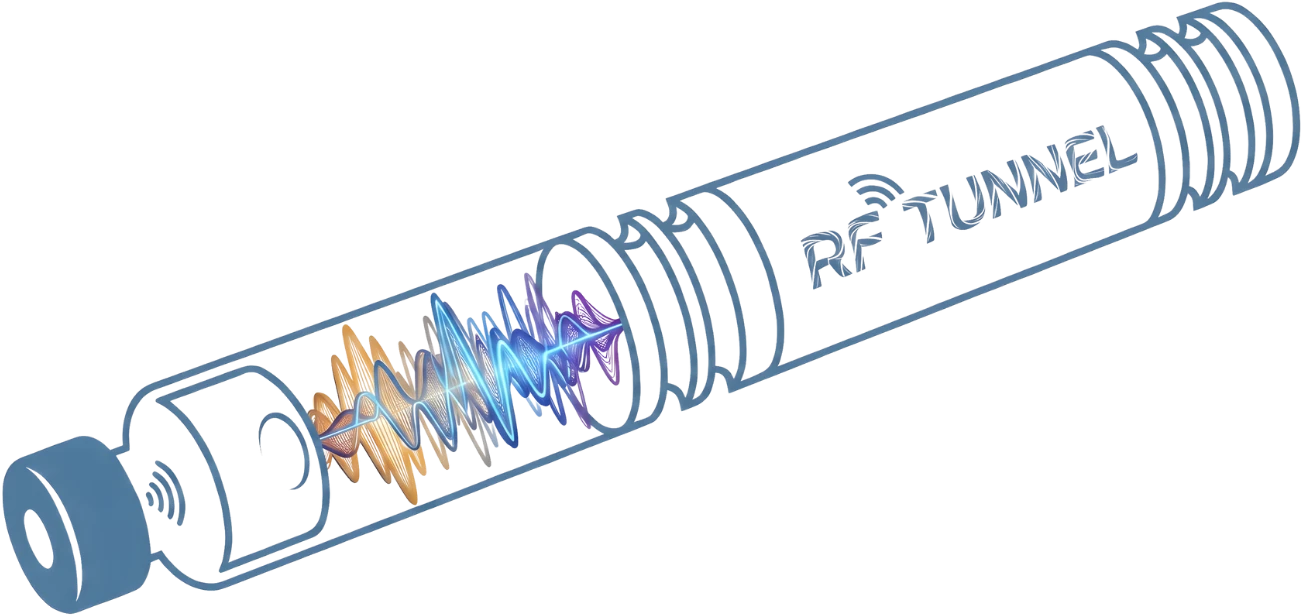
RF Tunnel™
The RF-formed central channel through the cake.
Two wetting fronts instead of one — reconstitution solved by geometry, not surfactants.
The hard cases: heavy-loaded, lipidated (GLP-class) and gel-blocking APIs.

TgShift™
Raises the cake’s glass-transition temperature with RF — instead of chilling below it.
Drying runs warmer and faster while the structure stays below collapse — cycles shorten from days toward hours.
Reference points: trehalose ≈ −29 °C, sucrose ≈ −32 °C — shifted upward, not endured.

Cryolapse™
Cryogenic pressure collapse under S3Pulse™ control — vapour redistributed through the whole cake, not its surface, impeding crust formation.
A collapse, not a yank: vapour redistributes gently through the whole lyocake instead of being driven off its surface, which impedes crust formation. Cryopumping to −110 °C, surfactant-free.
A representative peptide cycle pulled from ~13 hours toward ~4, without a surfactant in sight.

LyoLevit™
The cake levitates and spins in high orbit — driven by ultrasound and RF.
Company-reported zero-contact processing: 99% reproducibility, 89% energy reduction, a 4–6× gain in sublimation surface.
No shelf contact means no hot spots — uniformity is the mechanism, not the hope.

Lyochrysalis™
The integrated chamber housing the whole drying stack.
It finishes cold — it never cooks the peptide. No +40/+60 °C secondary bake, so binding affinity and bioavailability survive.
TgShift + LyoLevit + Cryolapse + DiastolVAC + S3Pulse in one housing.

S3Pulse™
The control brain for every piece of Panacea hardware.
Sixteen relay channels, three dipped product probes as the authority, Cryo-Triad event detection and a Kv-learning adaptive ramp — the only platform that enables every other technology.
14,909 automated contract tests stand behind the control law.

Liquiprester™
The single-liquid cartridge engineered so multiple peptide APIs coexist in one shared vehicle.
The glass may vary, the dose must not: a fixed plunger datum with ElimiVoid, bore-variance self-counterbalancing, and IncreSure verification per increment.
Dose accuracy that survives manufacturing tolerance — by design, not inspection.

Syntheseract™
Continuous-flow peptide synthesis in a special, very fast and economical way.
Batch synthesis is “more product, blindly”; Syntheseract is scalable production, observed — 64 positions, 128+ addresses, and a Digital Batch DNA for every run.
Sprint, Economy and Fortress modes — the economics chosen per peptide, not per habit.

CFSPPS™
Continuous-flow solid-phase peptide synthesis, written as its own category.
Setpoint ≠ experience: in flow, every residue addition is observed and repeatable instead of assumed.
The category reference the field reads before arguing.

OxyDeplete™
Degassing plus no-headspace doctrine — the oxygen-starved seal.
Trapped oxygen does not escape, it reacts. Remove it first and stability extends into years instead of months.
Air seal vs oxygen-starved seal: the comparison the oxidation model is built on.
ArgonLock™
The final inert-atmosphere lock under argon.
After drying, the cake is backfilled and sealed under argon — the principle that protects welding arcs, wine cellars and the Charters of Freedom, applied to peptides.
Air vs vacuum-only vs ArgonLock — the three-face comparison, settled.

RedoxVault™
Separation, not merely suppression — redox isolation in lipid micro-reservoirs.
A few ppb of iron can outweigh grams of antioxidant; the vault removes the catalyst from reach, with depot and delayed-release microsphere formats on top.
A strongroom at the scale of a droplet — the ferritin principle, engineered.

PleniDose™
The shared filling gantry — one machine filling both the dual-chamber Lyoprester and the liquid Liquiprester.
Only the rods holder changes between the two product lines; the rear-plunger datum is fixed and pen-compatible. The glass may vary — the dose must not.
Known inside the machine software as the Lyochrysalis Gantry: one gantry, two product lines.

IncreSure™
The dose-metrology layer — verified API per pen increment.
The printed “60 IU” dial figure is not the API in the cartridge and not the volume per click. IncreSure characterises seven real pen parameters instead of trusting the label — a Cryolapse-enabled discipline.
Piston travel per increment: measured, never assumed.

ElimiVoid™
Front-void elimination without touching the metered dose.
It removes the compressible air pocket ahead of the dose — without moving the rear plunger, without withdrawing API, without changing the delivered increment. A Cryolapse-enabled operation.
The completion liquid is API-free, buffer-free and engineered to stay out of the way.

Cryoviscous™
The characterised cold, high-viscosity, low-mobility conditioning state.
The formulation is held temporarily still — strongly flow-restricted — for precision cartridge filling, then recovers within acceptance criteria on controlled warming.
A processing state, not merely “cold liquid”.

Vana Machine™
Vacuum Assisted Needle Accessory — vacuum conditioning and plunger-locking for the cartridge.
It prevents air gaps and plunger drift, landing the target vacuum inside the Lyopresters and keeping it there until the moment of use.
The machine that vacuum-conditions the cartridge before it ever meets a needle.

EZnject™
The disposable auto-injector pen built around the Lyoprester.
One twist activates autoreconstitution — the P-EARLs is drawn into the peptide chamber at the septa. A hundred indexed 0.1 mL doses with lab-grade accuracy; ships with 31G/5 mm needles and a Peptourbillon pre-loaded.
One twist — no vial, no syringe, no transfer.

Dicoias Ψ
The computed-chemistry advisory — every substance reduced to a vector across physical, electronic and formulation space.
Structure-guided descriptors first, laboratory work second: the Ψ advisory ranks excipients, vehicles and layer candidates before the first bench run — the selection layer behind Panacea formulation decisions.
The molecule’s structure reads the shortlist before the bench hears it.

SealoPrester™
Aseptic Cartridge Closure System — Seal o’ Precision + Sterility.
It mechanically seals the caps of vacuum-charged, argon-locked cartridges that arrive held together by vacuum alone — one wrong move and the cartridge self-reconstitutes or loses its atmosphere. In cahoots with VANA, it gives birth to the Lyoprester.
The machine that turns a banal dual-chamber cartridge into a Lyoprester.

Peptidic Liquid
The peptide formulation in solution — the active plus its buffers, cryoprotectants, lyoprotectants and scaffolders.
A peptide is only as good as the liquid it lives in: this is the formulation that decides whether a dose survives freezing, drying, storage and the journey back to solution. Designed with Dicoias Ψ.
The liquid every Lyoprester is born from and every Liquiprester keeps.

DiastolVAC™
Biomimetic diastolic vacuum control — the pneumatic circulatory system of the machine: pumps, valves and sensors as one ensemble.
The heart fills by gentle pressure difference, not by force. DiastolVAC governs freeze-dry pressure the same way — sensor-led, gradual — instead of the brute pump-draw that flash-boils a fragile cake or collapses it. It is what makes Lyochrysalis an advanced lyophilizer under S3Pulse control.
Not one valve and not one pump — the whole pneumatic system, breathing in diastole.

KineticON™
Motion Integrity Architecture — the motion-control layer that lets the machine know what happened on every axis move.
Important motion runs as a persistent transaction (MotionProof), coordinate frames carry identities and histories (FrameProof), and every position comes back with its provenance (StateWitness) — the controller layer owned by the machine builder, not a vendor black box.
Born on the PleniDose gantry, where the machine builder took ownership of the controller layer.
The cosmonaut racetam, audited by evidence.